




If you’ve ever walked into a hardware store and felt like the insulation aisle was judging your bank account, you’re not alone. Most homeowners look at the price tag of R30 and then at the R20 roll, wondering, “Is that extra thickness actually doing anything, or am I just buying expensive fluff?”
In the world of home improvement, we often fall for the “More is Better” trap. We think doubling the R-value doubles the comfort. But physics doesn’t work that way. Today, we’re going to find the “Sweet Spot” between these two heavyweights. Whether you are looking for the best insulation for your roof or trying to fix a drafty floor, let’s talk facts—not marketing fluff.
R20 vs R30 Insulation:
| Feature | R20 Insulation | R30 Insulation |
|---|---|---|
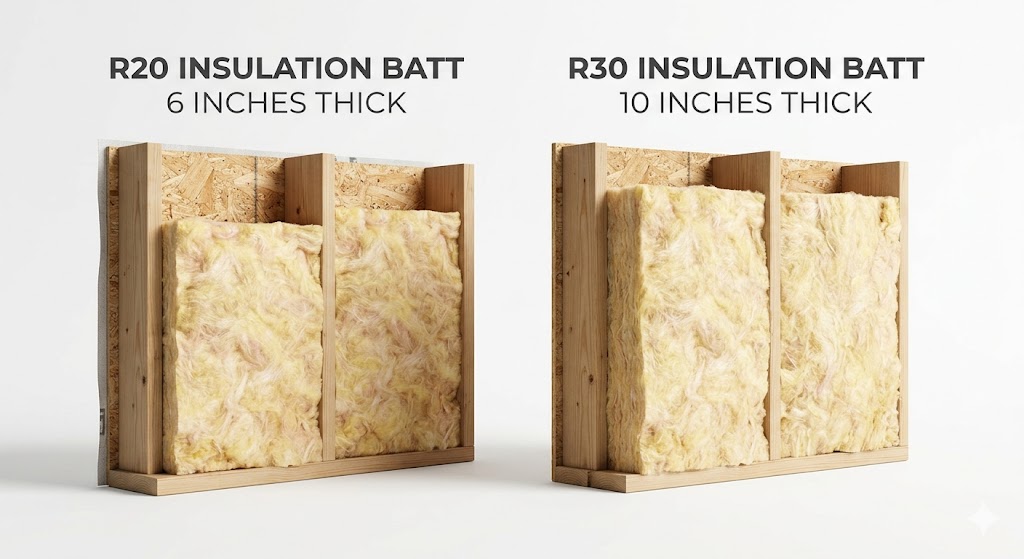
| Material Thickness | ~5.5 to 6 Inches | ~9.5 to 10 Inches |
| Heat Flow Resistance | Stops ~95% of Heat | Stops ~97% of Heat |
| Best Placement | Exterior Walls | Attics, Ceilings & Floors |
| Cost Estimate | $0.80 – $1.50 per sq. ft. | $1.20 – $2.10 per sq. ft. |
As you can see, R30 is nearly 4 inches thicker than R20, but the actual thermal performance gap is only about 2%.
“If you’re stuffing R30 into an R20 space, you’re basically paying for performance you’ll never get.”
Is R30 Really 50% More Effective Than R20 for Your Home?
On paper, R30 is 50% “stronger” than R20. But here is the kicker: The law of diminishing returns is a brutal reality in insulation.
Think of it like wearing blankets in winter. The first blanket keeps you from freezing (massive gain). The second blanket makes you cozy (good gain). By the time you’re under five blankets, adding a sixth one doesn’t make you “more” warm; it just makes it harder to breathe.
The math is simple:
- R20 stops about 95% of heat flow.
- R30 stops about 97% of heat flow.
You are paying significantly more for a 2% improvement in thermal resistance. In many cases, R30 is better, but the price jump isn’t always justified by the energy savings on your 2026 utility bill.
Why Does R20 Often Outperform R30 in Standard 2×6 Walls?
This is where most DIYers—and even some “pros”—mess up.
Does Compressing R30 Into a Small Space Kill Its Efficiency?
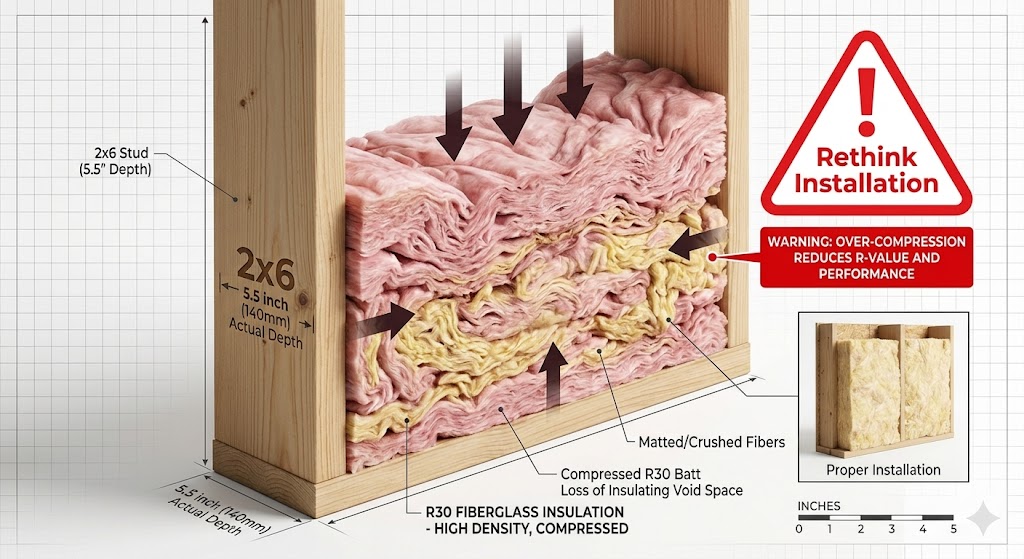
Imagine you have a standard 2×6 wall. A 2×6 stud is actually only 5.5 inches deep. An R20 insulation batt is designed to be exactly that thickness. It fits like a glove.
Now, imagine you buy R30 batts, which are about 10 inches thick, and try to “stuff” them into that same 5.5-inch cavity because you want “maximum protection.”
You just killed your R-value. Insulation works by trapping tiny pockets of air. When you compress R30 into a 6-inch space, you squeeze out the air. You’ve effectively turned your high-end insulation into an expensive, dense brick that might perform worse than a standard R20 batt.
Can R20 Be the “Gold Standard” for Modern Energy-Efficient Walls?
For most exterior walls, R20 is the sweet spot. It provides the maximum thermal resistance possible for the physical depth of the wall without causing moisture issues or structural bulging. Unless you are building custom double-stud walls, R20 is usually your champion.
Are You Fighting the Winter Snow or the Scorching Summer Sun?
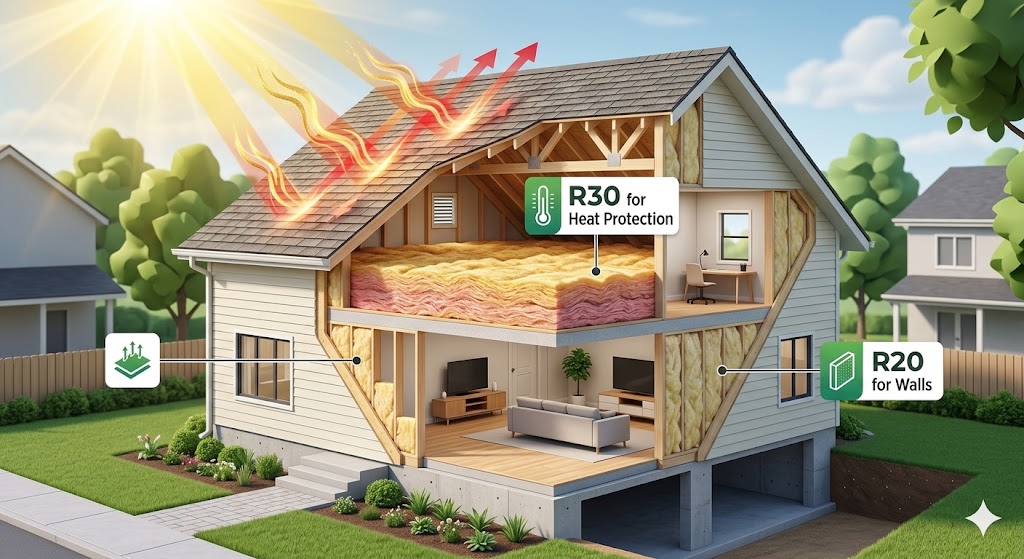
Most people think insulation is just for keeping the heat in during the winter. If you live in a warm or moderate climate (like Climate Zones 1-3), insulation is actually your AC’s best friend.
Why Is R30 the Minimum Requirement for Your Attic in 2026?
Your roof is basically a giant radiator sitting on top of your head. In the summer, attic temperatures can soar above 150°F (65°C).
While R20 is great for walls, it’s often insufficient for attics. Heat moves in three ways: conduction, convection, and radiation. An attic floor needs that extra “bulk” of R30 (or even R49) to keep that radiant heat from seeping through your ceiling and making your AC work overtime.
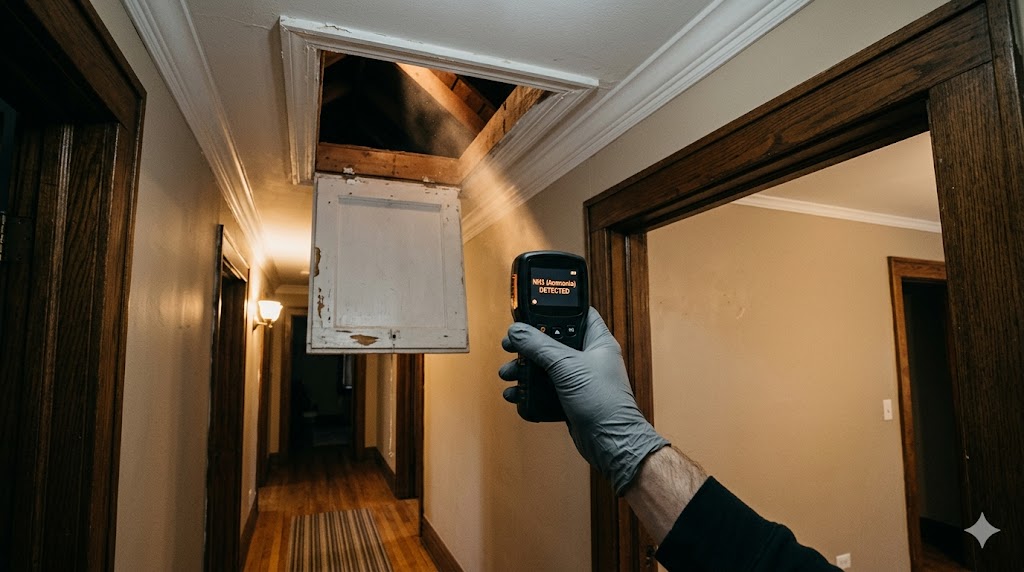
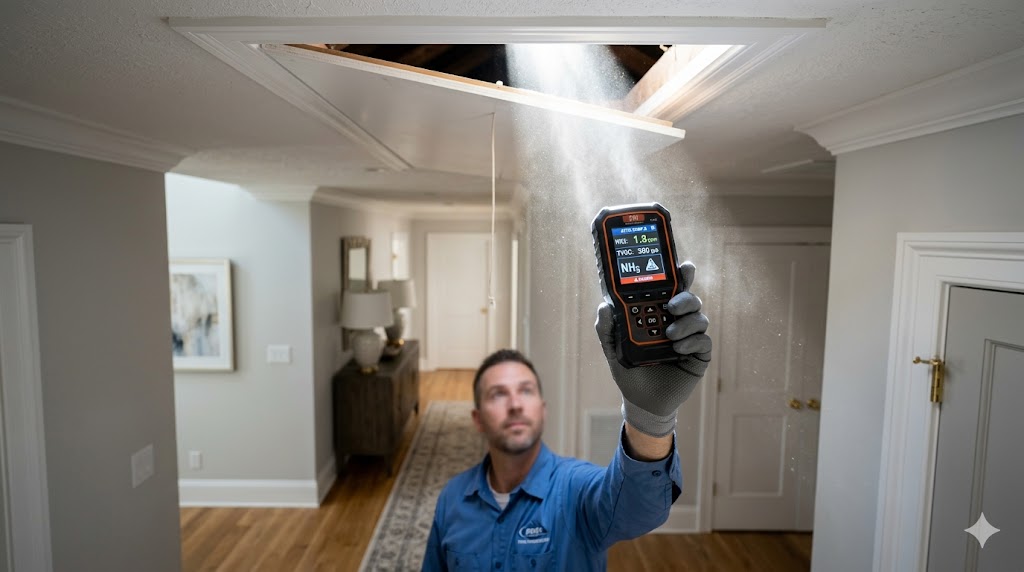
However, be careful—if you choose the wrong material or let moisture build-up, you might end up identifying strange odors from your insulation that signal a chemical breakdown rather than a performance gain.
Is R20 Enough for Floors Over Unheated Crawl Spaces?
Crawl spaces are tricky. They are damp, dark, and usually the source of cold feet in the winter. If you are researching the best insulation for crawl spaces, R20 is often the recommended baseline.
Because crawl spaces don’t face the direct “oven-effect” of the sun like an attic does, R20 provides a solid barrier against the rising damp and cold from the earth. However, the type of batt insulation for crawl space matters more than the number (more on that below).
Does the Material Choice Matter More Than the R-Value Number?
A “30” isn’t always a “30.” The material you choose changes how that number actually feels in your home.
Why Should You Choose High-Density Fiberglass Over Standard Batts?
Standard fiberglass is loose and airy. High-density (HD) batts are packed tighter at the factory. An HD R21 batt can sometimes fit into a 2×4 wall where a standard R13 would usually go. If you are tight on space but want higher performance, always look for the “HD” label.
Is Spray Foam R20 Better Than Fiberglass R30?
This is the “Secret Sauce” of 2026 home efficiency: The Air Sealing Angle. Fiberglass is like a wool sweater. It keeps you warm, but if the wind blows, it goes right through the holes in the knit. Spray foam is like a windbreaker.
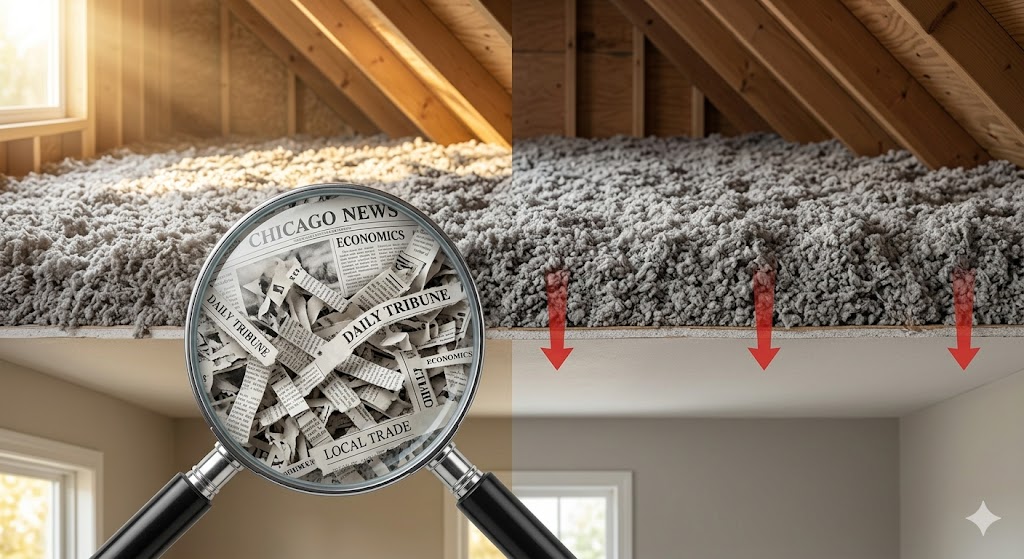
An R20 spray foam application often outperforms an R30 fiberglass batt because the foam seals all the tiny cracks and air leaks. If your house is “leaky,” no amount of R30 fluff will save you. If you are looking for a more eco-friendly approach, you might evaluate if choosing cellulose is right for your attic compared to traditional fiberglass batts.
What Is the Real-World Payback Period for Upgrading to R30?
Let’s talk about your wallet.
Will You Recover the Cost of R30 in 3 Years or 10 Years?
In a moderate climate, the jump from R20 to R30 in your walls might take 10 to 15 years to pay for itself in energy savings. However, in an attic, the payback is much faster—usually 3 to 5 years.
Why? Because attic heat loss/gain accounts for nearly 25-30% of your total energy bill.
Is Your Local Climate Zone Making Your Insulation Choice Obsolete?
If you live in Zones 1, 2, or 3 (think warm, humid, or moderate areas), your biggest enemy is humidity and radiant heat.
- In these zones: You don’t need the extreme R-60 values used in Canada, but you do need a perfect vapor barrier.
- Installing R30 without a proper moisture barrier in a humid zone is a recipe for mold.
Conclusion: Which One Should You Buy Today?
After looking at the facts, the winner depends entirely on where you are putting it.
- For your Walls (2×6): Stick with R20. It fits perfectly, avoids the “compression trap,” and gives you the best bang for your buck.
- For your Attic: Go with R30 (or higher). Your roof takes the most heat, and this is where the extra thickness actually pays off.
- For your Crawl Space: R20 is usually sufficient, provided you focus on moisture control and air sealing.
The Expert Verdict: Don’t just chase the highest number. Insulation is about the system, not just the roll. A perfectly installed R20 batt will always beat a poorly stuffed R30 batt.
Stop buying fluff you don’t need, and start sealing the leaks you didn’t know you had. Your 2026 energy bill will thank you.
❓ Frequently Asked Questions
Can You Layer R20 and R30 Insulation Together?
Absolutely. This is known as “layering” or “stacking.” If your attic already has R20 insulation and you want to give it some extra “punch,” adding a layer of R30 is a brilliant move. Just keep one golden rule in mind: install the new layer perpendicular (at a 90-degree angle) to the existing one. This crisscross pattern is highly effective at sealing air gaps. However, never place “faced” insulation (the kind with a paper backing) on top of another layer. Doing so creates a secondary vapor barrier that can trap moisture and eventually rot your wooden framing.
Does Higher R-Value Mean Better Mold Protection?
How Many Decades Will Your Fiberglass Insulation Last?
Is R30 Too Heavy for a Standard Drywall Ceiling?
Standard ceiling joists and drywall are designed to easily handle the weight of R30. The real danger only arises if the insulation gets wet. Wet insulation can become 10 times heavier than its dry weight, which is when you face the very real risk of a ceiling collapse.
Sources:
- International Residential Code (IRC) 2021/2024 Energy Efficiency Standards.
- Department of Energy (DOE) Insulation Fact Sheets.
- ASHRAE Handbook of Fundamentals.


1 thought on “R20 vs R30 Insulation: Is the Extra Cost Actually Saving You Money?”
Excellent explanation, thanks!